top of page

15 t sprocket + spacer for SRAM / SACHS 6 speed Bromptons

€15.70
In stock: 11 available
Save this product for later
Share this product with your friends
15 t sprocket + spacer for SRAM / SACHS 6 speed Bromptons
Product Details

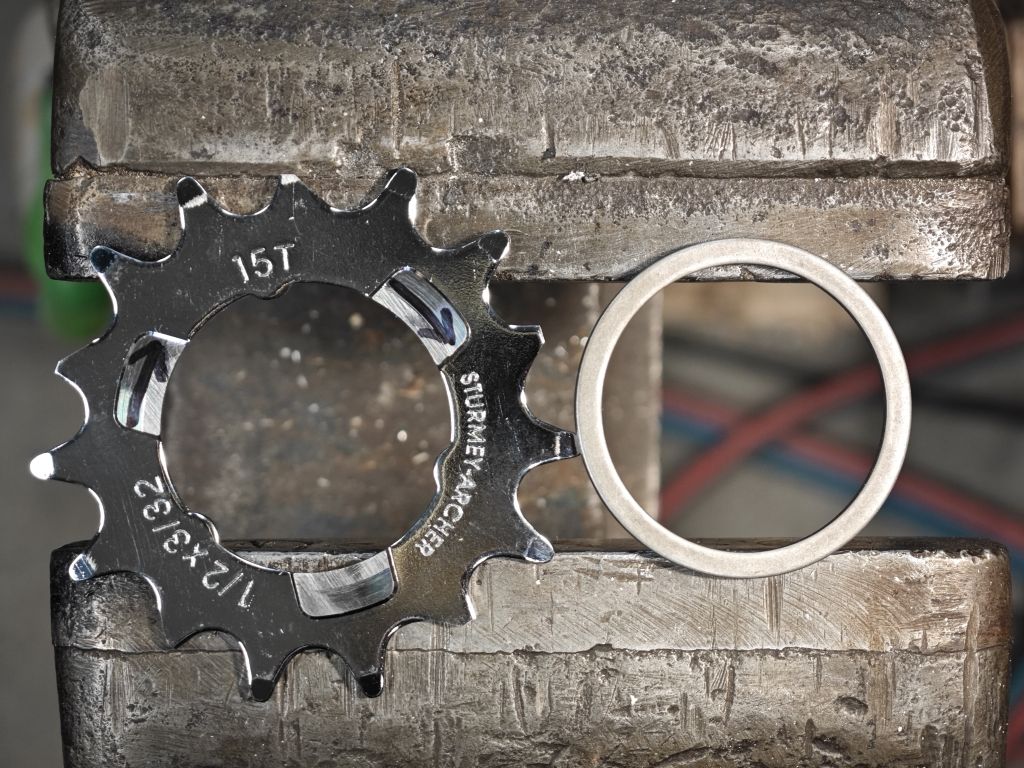
Sturmey Archer x Eerder 15 teeth sprocket for the Sachs 2x3 gear system introduced in 2002. As Brompton stopped supplying these, because demand was too little, I started making exact copies of the original Sach sprockets years ago. I use Sturmey Archer 15t 1/2" x 3/32" sprockets and machine down the raised areas to get a thickness of 2.6mm. Also 5 of the teeth are ground down to the original special shape to improve shifting performance. Mind the direction of rotation indicated with an arrow. It should be mounted clock wise with the raised areas facing outwards. When used in conjunction with the original 0.85mm Nylon chain disc + the supplied 1.6mm spacer ring + a 13t sprocket (flange step facing inwards) (still available at your local Brompton dealer) + the original spring clip it's all snug and without play. Just a new chain and you're ready to roll for a couple thousand kilometers.

Some background info on the 2x3 system:

In the early two thousands it was a turbulent time for internal gear hub makers world wide. In September 2000 Sturmey Archer ceased trading as a result of bankruptcy. The 5 speed Brompton was withdrawn when stocks of hubs were exhausted. And in April 2001 the 3-speed Sturmey hub was replaced by Sram hubs after Sturmey 3- speed stock had been used up as well. These Sram hubs were branded as Sachs hubs on the left dust cover as Sachs had recently been taken over by Sram USA. In April 2002 the Brompton 2 x 3 was finally introduced to fill the gap left by the discontinuation of the Sturmey 5-speed Sprinter hub. This system was used for 7 years with the Sram hub and continues untill today with a Sturmey Archer hub. Sturmey had been bought by Sunrace Taiwan in 2000 and some twenty container loads of equipment were shipped to Taiwan. The first Taiwanese Sturmey hubs were shipped to the UK in June 2001, but it took till 2009 for Brompton to switch over to Sturmey hubs for their 2x3 models.
The following text is written by David Henshaw in his excelent Brompton bicycle book:
The Six-speed Emerges
Andrew Ritchie and his team had decided to put a 2-speed derailleur on the nose of a 3-speed hub producing a 6-speed bike, and this was one reason SRAM had been asked to produce a custom hub with room for two sprockets. This arrangement would have several advantages and a few disadvantages. The gear range (the difference between the lowest and highest gears) would be a little narrower than the former Sturmey 5-speed hubs, but without the inherent inefficiency of the 5-speed's wide-ratio gears, this wouldn't be a great issue. Perhaps more of a problem was that there would now be two gear triggers, something that users had found so confusing on the original 5-speed. There would be a slight weight penalty too, but some intriguing prospects for saving weight on certain models, because the 2 speed derailleur could be fitted without a hub gear to a future lightweight 2 speed version of the bike. This was uncharted territory for Brompton. The company would have to design a complex and belleur assembly, plus a new derailleur trigger, again quite unlike anything else, and the systems would have to be prototyped, tested and put into production as soon as possible, because the lack of a multi-gear bike was losing customers and hitting the profitability of the bikes that were being sold.
Design and testing of the 6-speed Brompton took exactly a year, and in April 2002, the new was introduced. As always, it was carefully thought through and meticulously engineered. The Brompton had always been fitted with a chain tensioner to take up the slack in the chain when the bike was folded, effectively packing the chain away when out of use. In a bit of classic Anthew Ritchie ingenuity, the tensioner now performed a second role, keeping the chain correctly tensioned as the rider changed between the two derailleur gears.Technically, it was quite interesting. The derailleur idler wheels were allowed to 'float' on their mounting bolts to align with either of the two sprockets fixed to the input 'driver' of the gear hub. Derailleur changes were accomplished with a little shifter that pushed the chain one way or the other, and was controlled by a second lever on the handlebars....
More about this clever design in the Brompton bicycle book.
  • Facebook - White Circle
  • Pinterest - White Circle
  • Instagram - White Circle

© 2019 by Vincent van Eerd

bottom of page